Someone Is Screaming in the Lane
Someone Is Screaming in the Street. And Suddenly, You Might Be Part of the Chase.
You've heard the alarm.
Someone has raised the hue and cry.
And if the alarm is calling people to pursue a suspected offender, you weren't necessarily allowed to shrug, shut your door and carry on with your day.
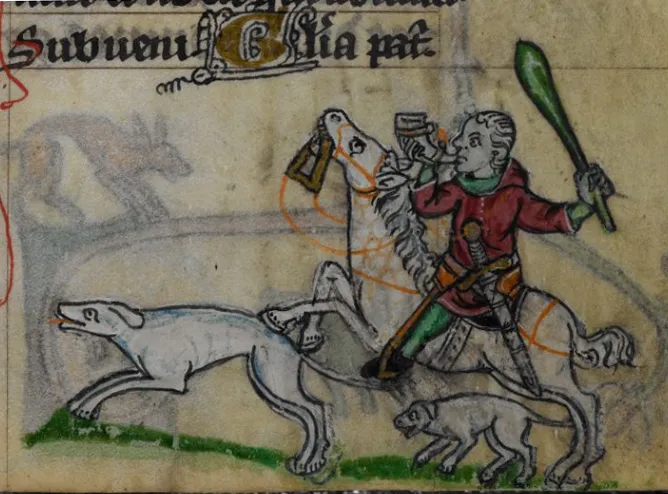
This is a mounted horn-blower, from the Maastricht Book of Hours, made in England around 1300–1325.
The image doesn't show us a specific hue and cry, but horns and cries were part of the wider system of raising an alarm and calling people to pursue an offender.
The idea was surprisingly simple.
Someone committed an offence.
The alarm was raised.
The cry spread from person to person.
And people were expected to help with the pursuit.
It was a way of maintaining the peace in a world without a modern police force.
And this wasn't just some vague medieval custom. By 1285, the Statute of Winchester set out rules concerning the raising and pursuit of the hue and cry. :contentReference[oaicite:1]{index=1}
So imagine you're baking bread.
Or milking a cow.
Or halfway through an argument with your neighbour.
And suddenly the alarm goes up.
You might have to stop what you were doing and join the pursuit.
Exactly what was required depended on the circumstances and the local legal system, but ignoring the hue and cry was not simply a matter of saying, “Sorry, I'm busy.”
The system mattered because keeping the peace wasn't left entirely to professional officials. The community itself could be expected to raise the alarm, pursue suspects and help bring them before the authorities. Medieval legal records show the hue and cry operating in both rural and urban communities. :contentReference[oaicite:2]{index=2}
No police siren.
No CCTV.
No emergency services.
Just a shout, a horn, and suddenly half the neighbourhood might be involved in chasing someone down the road.
Really?
That was a thing? Well... okay then.
Source
- Statute of Winchester, 13 Edward I (1285).
- Maastricht Book of Hours, British Library, Stowe MS 17, f.126r, England, c.1300–1325.
- Samantha Sagui, “The hue and cry in medieval English towns,” Historical Research, 87:236 (2014).