Dubious Deeds
Court cases, petty feuds, terrible decisions and medieval people behaving badly.
-
The Wall Was Fine. The Hedge Wasn't.
Two neighbours. One hedge. One perfectly innocent wall. And two fines.
Walter Mile complained that his neighbour, John Brochole, had unlawfully put up a wall and a hedge between their holdings.
John readily agreed to have the matter investigated...
The court did investigate.
- The wall was fine.
- The hedge was not.
John was fined for putting it up and ordered to make amends.
So far, so straightforward.
Except Walter had also accused him of unlawfully putting up the wall.
And that bit wasn't true.
So Walter was fined too — for making a false claim.
I bloody love this one because the ending is so wonderfully unsatisfying.
Nobody really won.
Which, frankly, feels about right for a medieval neighbour dispute.
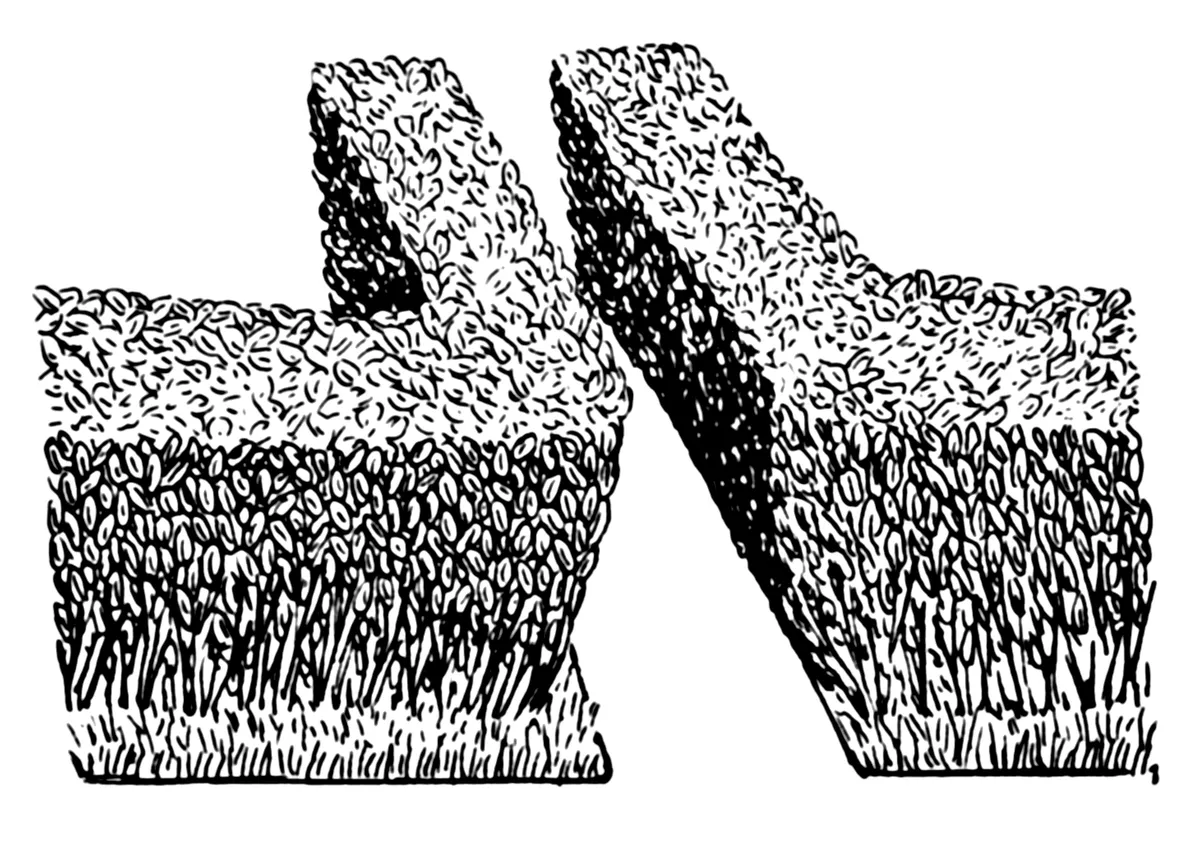
Illustration of a hedge. Pearson Scott Foresman, via Wikimedia Commons. Public domain. Source
Weedon Beck, Northamptonshire. Court held on the Saturday next after the feast of St Margaret, in the twenty-fourth year of Edward I, AD 1296.
-
The Insufficiently Accused Oxen
Four oxen, one technicality, and two neighbours who clearly had history.
In 1258, Roger Eyre of Cranfield took Elias of Stratford to the manor court.
A straightforward accusation. Or was it?
Roger said Elias had wrongfully taken four of his oxen and kept them. The loss had caused Roger such damage and shame that he claimed it was worth half a mark.
But Elias spotted a problem.
Roger hadn't said what year the alleged theft had happened. He hadn't given the value of the oxen, or said where Elias had taken them.
“Roger has insufficiently accused the said Elias.”
Elias argued that the accusation was therefore too vague for him to answer.
The court agreed.
Elias went “without day” — the case was dismissed — while Roger was put in mercy for bringing an insufficient complaint.
You might think that was the end of it.
It wasn't.
Elias immediately brought a complaint against Roger for trespasses committed against Elias and his mother.
“Also Elias of Stratford complains of Roger Eyre of Cranfield for trespasses done to Elias and his mother.”
Roger then asked for the proper summonses — formal notice of Elias's complaint against him — and the court agreed. Both men had to provide pledges — people who would stand behind their promises to the court. Roger even put his property up as a guarantee and promised not to cause any more trouble for the Abbot's tenants in court.
So somewhere behind this very dry court entry are four oxen, two unhappy neighbours, a mother caught up in the dispute, and apparently a much longer-running feud.
Sadly, the court roll doesn't tell us what happened next.
Damn it.
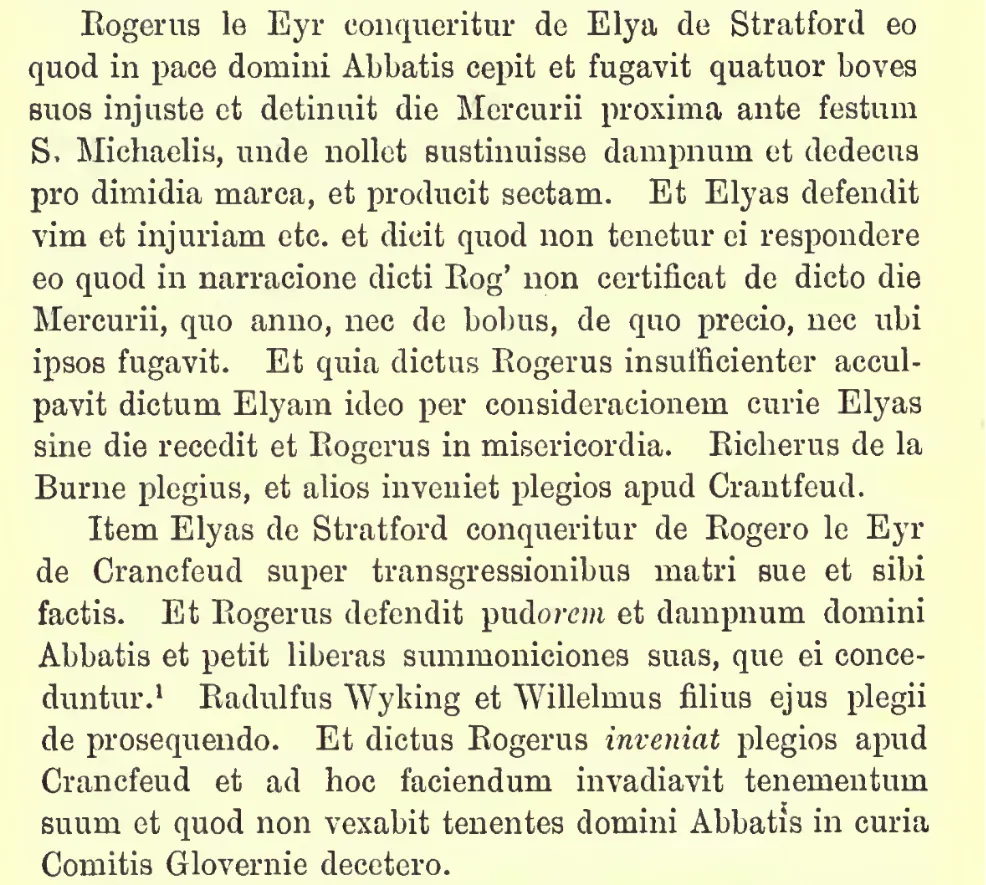
Broughton manor court roll, 1258, p. 56. Roger Eyre's complaint against Elias of Stratford, followed by Elias's complaint against Roger. -
Breaking the Beer Rules in 1289
Twelve people. One court session. And all of them had broken the rules.
In 1289, something was going wrong with the beer in Bledlow.
The ale-tasters had been keeping an eye on things...
And they had names.
Twelve of them.
Richard Hull.
Agnes Holemere.
Gregory Miller.
Joan Moor.
Maud Pholip.
William Kavening.
John of Grateley.
John Fellow.
Hugh Wiking.
Hugh Churchyard.
John Newmere.
And John Brown.
All twelve were presented at the manor court for breaking the assize of beer.
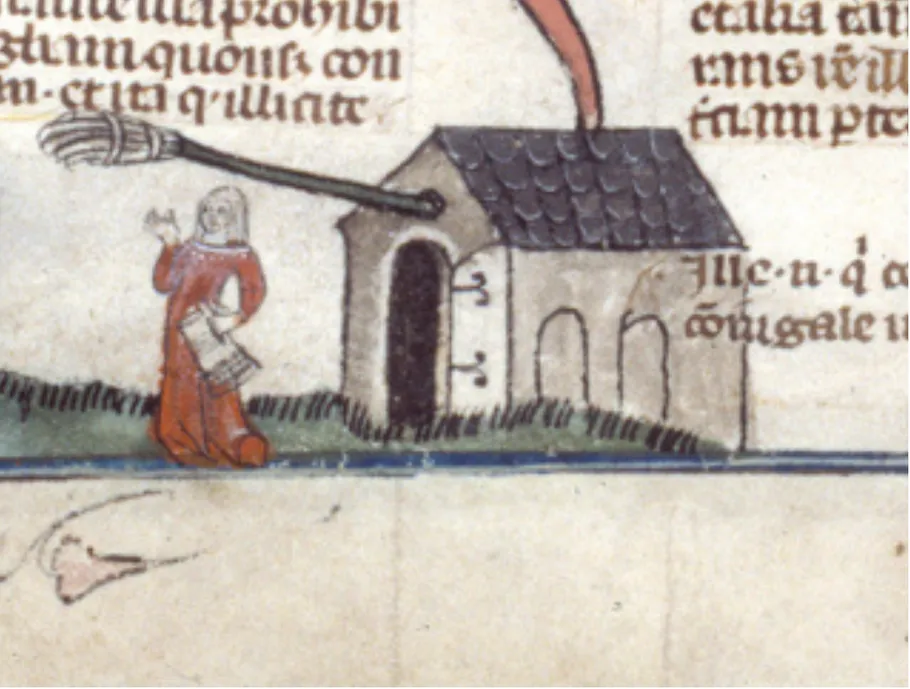
An alewife at work in a brewhouse, from the Smithfield Decretals, Royal MS 10 E IV, f.114v, c.1300–1340. British Library. And the punishment?
A fine.
Richard Hull paid 6d.
Agnes Holemere, 3d.
Gregory Miller got the full 12d.
Joan Moor and Maud Pholip paid 3d each.
Most of the others were fined 6d.
Hugh Churchyard also got 12d.
And that was that.
No great scandal.
No dramatic confrontation.
Just twelve people caught breaking the rules about beer, all appearing in the same court sitting and all being fined for it.
Which is perhaps the most interesting part.
Because this wasn't some extraordinary event that brought the whole village to a standstill.
It was routine court business.
The ale-tasters found people breaking the assize.
They reported them.
The court fined them.
And everyone presumably got on with making, selling and drinking the stuff.
The record doesn't tell us exactly what each person had done to break the assize. It simply gives us the names, the offence and the fines.
But twelve names in one sitting tells us something rather nicely.
Medieval people were apparently breaking the beer rules often enough for the village to have officials whose job was to catch them.
And in 1289, getting caught meant paying your few pennies and carrying on.
Beer was serious business.
Apparently, so was getting it slightly wrong.
Source: F. W. Maitland, Select Pleas in Manorial and Other Seignorial Courts, p. 33. Manor Court of the Abbey of Bec, Bledlow, Buckinghamshire, court held on St Luke's Day, 18 October 1289.
Image: An alewife in a brewhouse, The Smithfield Decretals, Royal MS 10 E IV, f.114v, c.1300–1340. British Library. Public domain.
-
He beat up a priest, then called the cops on himself
Then He Raised the Alarm — on Himself.

F. W. Maitland, Select Pleas in Manorial and Other Seignorial Courts, p. 167. The entry concerning Henry Smith and Sir Robert the chaplain. In 1294, in Brightwaltham, Berkshire, a man called Henry Smith struck Sir Robert the chaplain and drew blood.
Then he did something nobody expected.
He didn't run. He didn't hide.
He raised the hue and cry.
That's the medieval emergency alarm — the one where you shout, your neighbours shout back, and the whole village drops what it's doing to chase whoever's responsible.
Henry raised it himself. On himself.
The court says he did it “to conceal his fault.”
It didn't work.
Henry was left at the mercy of the court. Three men — John Atgreen, Richard Young and Thomas Smith — were named as his pledges.
Nice try, Henry. Nice try.
Source
F. W. Maitland (ed.), Select Pleas in Manorial and Other Seignorial Courts, Selden Society, Vol. I, 1889, p. 167.
-
His Solution to a Neighbour Dispute? Throw Rocks at the House.
He threw stones at his neighbour's door.
In the middle of the night.
Then his neighbour raised the hue and cry.
It's 1249, in Ogbourne, Wiltshire.
A man identified in the court record as Robert Carter's son went to the house of Peter Burgess after dark.
And started throwing stones at his door.
Peter responded by raising the hue — the medieval public alarm that called on neighbours to come and help pursue an offender.
The court record tells us:
“It was presented that Robert Carter's son by night invaded the house of Peter Burgess and in felony threw stones at his door so that the said Peter raised the hue. Therefore let the said Robert be committed to prison. Afterwards he made fine with 2s.”
Robert was ordered to be committed to prison.
Then he made a fine of two shillings.
And that's where the record leaves us.
But why was he throwing stones?
We have absolutely no idea.
The court doesn't tell us what had happened between Robert and Peter beforehand.
We don't know whether there had been an argument.
We don't know whether Robert had been drinking.
We don't know whether Peter had done something to annoy him.
We don't even know whether the stones actually hit the house, although the record certainly makes it clear that Peter thought the incident serious enough to raise the hue.
All we have is the aftermath.
Robert went to Peter's house at night.
He threw stones at the door.
Peter raised the alarm.
Robert ended up before the court.
And two shillings later, presumably, everyone went home.
And that is the brilliant thing about court records.
They don't give us a neat story with a beginning, middle and satisfying explanation.
Sometimes they give us a tiny glimpse of something that happened to two people nearly 800 years ago.
We know what Robert did.
We know what Peter did.
We know what the court decided.
But the argument that started it all has disappeared.
Which leaves us with one extremely important unanswered question:
Peter, what did you do?
Sources
- Manor Court of the Abbey of Bec, Ogbourne (Wiltshire), Whitsun Week 1249. Translated manor court roll recording the prosecution of Robert Carter's son for attacking the house of Peter Burgess and the raising of the hue.