What On Earth?
The strange, surprising and downright WTF things medieval people got up to.
-
Someone Is Screaming in the Lane
Someone Is Screaming in the Street. And Suddenly, You Might Be Part of the Chase.
You've heard the alarm.
Someone has raised the hue and cry.
And if the alarm is calling people to pursue a suspected offender, you weren't necessarily allowed to shrug, shut your door and carry on with your day.

A mounted horn-blower from the Maastricht Book of Hours, England, c.1300–1325. British Library, Stowe MS 17, f.126r. This is a mounted horn-blower, from the Maastricht Book of Hours, made in England around 1300–1325.
The image doesn't show us a specific hue and cry, but horns and cries were part of the wider system of raising an alarm and calling people to pursue an offender.
The idea was surprisingly simple.
Someone committed an offence.
The alarm was raised.
The cry spread from person to person.
And people were expected to help with the pursuit.
It was a way of maintaining the peace in a world without a modern police force.
And this wasn't just some vague medieval custom. By 1285, the Statute of Winchester set out rules concerning the raising and pursuit of the hue and cry. :contentReference[oaicite:1]{index=1}
So imagine you're baking bread.
Or milking a cow.
Or halfway through an argument with your neighbour.
And suddenly the alarm goes up.
You might have to stop what you were doing and join the pursuit.
Exactly what was required depended on the circumstances and the local legal system, but ignoring the hue and cry was not simply a matter of saying, “Sorry, I'm busy.”
The system mattered because keeping the peace wasn't left entirely to professional officials. The community itself could be expected to raise the alarm, pursue suspects and help bring them before the authorities. Medieval legal records show the hue and cry operating in both rural and urban communities. :contentReference[oaicite:2]{index=2}
No police siren.
No CCTV.
No emergency services.
Just a shout, a horn, and suddenly half the neighbourhood might be involved in chasing someone down the road.
Really?
That was a thing? Well... okay then.
Source
- Statute of Winchester, 13 Edward I (1285).
- Maastricht Book of Hours, British Library, Stowe MS 17, f.126r, England, c.1300–1325.
- Samantha Sagui, “The hue and cry in medieval English towns,” Historical Research, 87:236 (2014).
-
Eel Currency: Or, How England Paid Its Bills With Fish
In 1238, the monks of Ramsey Abbey agreed to pay 1,000 eels a year.
Not metaphorically.
Actual eels.
They also owed two pounds of pepper, two pounds of spice, and a pair of scarlet hose.
All of it was part of an agreement concerning a road across low-lying land near St Ives.
It sounds like someone has invented the strangest medieval shopping list imaginable.
They hadn't.
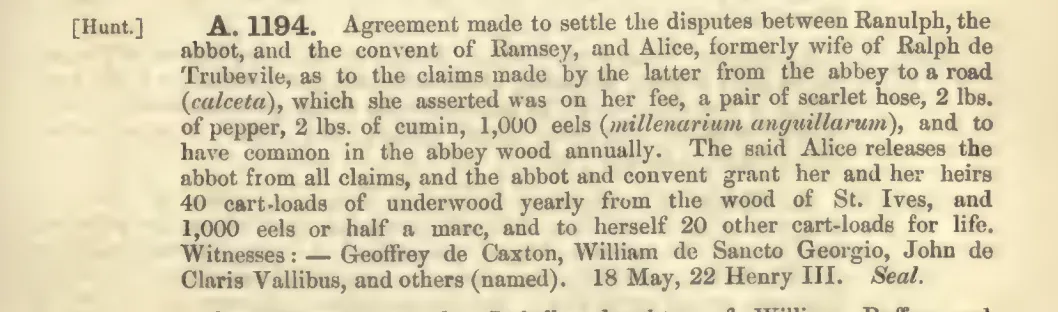
Record of the agreement between Ranulph, abbot of Ramsey, and Alice, formerly wife of Ralph de Trubevile, concerning the road, annual payments and common rights. A Descriptive Catalogue of Ancient Deeds in the Public Record Office, Vol. I, A.1194, 18 May, 22 Henry III (1238). Public domain. The arrangement was already an old one by this point.
Alice, the widow of Ralph de Trubevile, claimed rights connected with the road, the annual payment and common rights in the abbey wood.
So in 1238, she and the abbot of Ramsey settled the dispute.
And the new deal was even stranger.
She would receive 40 cartloads of underwood every year, 1,000 eels — or half a mark instead — and another 20 cartloads of wood for the rest of her life.
The scarlet hose disappeared.
The eels stayed.
Medieval England really did have eel rent.
Sources
- H. C. Maxwell Lyte (ed.), A Descriptive Catalogue of Ancient Deeds in the Public Record Office, Vol. I (1890), A.1194. The entry records the agreement between Ranulph, abbot of Ramsey, and Alice, formerly wife of Ralph de Trubevile, dated 18 May, 22 Henry III (1238). Digitised scan via the Internet Archive.
- Victoria County History: Huntingdonshire, Vol. II, pp. 309–314. The history of Hemingford Grey describes the causeway and the earlier annual payment of 1,000 eels, pepper, ginger and scarlet hose, with the arrangement altered in 1238.
- John Wyatt Greenlee, “Seeing All the Anguilles.” The research calculates 403,760 eels in the Domesday records and 539,785 when additional surviving charters are included.